

Evolution Towards 5G-Advanced
Introduction
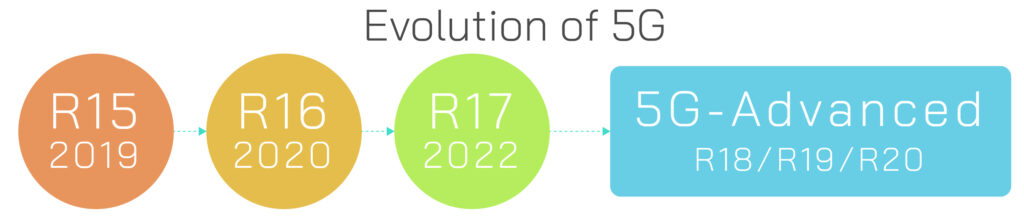
The ambitious goals of 5G are much more than enhanced mobile broadband. It refers to the complete solutions to fulfill all communication needs of the enormous IoT devices and vertical industries. According to 3GPP standard, the evolution of 5G has divided into two stages and each one is with 3 releases. R15/R16/R17 are in the first stage of 5G while R18/R19/R20 is the second innovation of 5G which is called 5G-Advanced.
During the process of the 5G evolution for eMBB, URLLC, and mMTC, each new release builds on the capabilities of the previous one. After years of development, 3GPP frozen the standard of 5G R17 in Q2, 2022. This indicates that the 5G technology standard has moved to a mature/steady period and the preparation of the first release of 5G Advanced, R18, has begun. Let us take a deeper look into the evolution toward 5G-Advanced.
Evolution of 5G
Release 15-Frozen in 2019
Focus on eMBB and define basic URLLC as a foundation of 5G technology
To come up with a 5G standard in a fastest way, R15 focuses on the basic function in the enhancement of the eMBB which has better efficiency of the transmission. In addition to the extreme mobile broadband service, R15 also focuses on Ultra-Reliable Low-Latency Communications (URLLC).
NSA and SA
As the first full release of 3GPP’s 5G standards, R15 is frozen in two distinct steps: specifications of the Non-Standalone Architecture (NSA) that 5G networks are deployed based on existing 4G equipment for earlier implementation were frozen in 2018 while specifications for the Standalone Architecture (SA) with faster networking and the support of network slicing were frozen in 2019.
5G network slicing is a network architecture that enables multiple unique logical and virtualized networks over the same physical network and makes each network slice an isolated end-to-end network tailored to achieve real-time performance, better utilization of resources, and higher security.
Although R15 may not be sufficient for various applications, it not only provides outstanding performance of the mentioned features of eMMB and partial URLLC. These features make 5G perform beyond what 4G is capable of and lead to a new era of mobile communication.
Release 16-Frozen in 2020
Improved eMMB and uRLLC/mMTC/location/V2X to support vertical applications
R16 is the enhanced version of the 5G to have further improvement of URLLC with finer reliability to expend the applications into vertical ones including the key areas of autonomous driving and Industrial IoT.
Vertical industries-V2X of ITS and TSN of IIoT
Regarding the intelligent transportation, it better defines the area of 5G V2X (Vehicle-to-everything/X) including V2V (Vehicle-to-vehicle), V2N (Vehicle-to-network), V2I (Vehicle-to-infrastructure), V2P (Vehicle-to-pedestrian), and the interaction between them. As for IIoT, it makes improved time sensitive networking of 5G NR based on integration with IEEE Time-Sensitive Networking (TSN) and increase system related capabilities including location, MIMO (Multiple-Input Multiple-Output), and power consumption.
NR-U for higher flexibility
Furthermore, R16 brings about NR-U (New Radio Unlicensed) to make the deployment of 5G private network much easier with simple installation procedure and the scalability for future expansion of the network capacity.
Release 17-Frozen in 2022
Speeding up the 5G development with enhanced eMMB and RedCap
R17 brings further enhancement to previous basic technologies, including coverage, latency, performance, mobility, etc. to support high-capacity URLLC with extremely low latency and advanced edge compute performance. R17 defines more precise location to fulfill the demands of AGV/AMR monitoring which requires high positioning accuracy in IIoT.
RedCap for cost-effective and sustainable edge communication
Another feature of R17 is RedCap (Reduced Capability) which is a new-define edge aiming to make up for the blind area among the three application scenarios. It targets to expand the scope of application by lowering the power consumption and cost of those low complexity 5G edges. This can be broadly implemented in industrial sensing, video monitoring, portable devices, etc.
With the frozen R17, it not only represents the successful completion of the first stage of 5G technology evolution (R15/R16/R17), but also symbolizes the second round of 5G innovation led by the next three versions Rel-18/19/20 is about to start.
Release 18-The start of 5G-Advanced
Aiming to have ultimate eMBB and popularize immersive new services such as XR
R18 as the first standard of 5G-Advanced targets to bring out the richest capabilities of 5G ever. In addition to high-precision location, the extended reality (XR) is one of the main focuses of R18. Further networking optimization is required to accomplish the ultra-low latency with wide broadband to ensure the XR experience will not remain uninterrupted. Also, the power efficiency would be enhanced further.
It is no doubt that 5G-Advanced will open many new possibilities for 5G connectivity and to those that we cannot imagine from the beginning of 5G or even now. With the fast-developed AI/ML data collection and analysis coupled with Open RAN and network management, let us look forward to innovative applications to provide better quality and sustainability!
Conclusion
With continuous enhancement of URLLC, eMMC, and mMTC, 5G standard are becoming more solid with the frozen R15/R16/R17. While continuing working on the evolution of 5G technology under 5G Advanced, more and more 5G related equipment manufacturers and solution providers are getting ready for the expanding commercial opportunities and we shall expect more to come with 5G and AI related application in emerging vertical markets.