


Scalable DDR5 Memory Solutions for Network Appliances and Servers
Introduction
Introduced in the late 1990s, Synchronous DRAM (SDRAM) revolutionized computer performance by replacing earlier asynchronous DRAM designs. System memory (RAM) acts as the temporary workspace between processors and storage devices (SSDs or HDDs) and increasing its bandwidth and capacity has long been one of the most effective ways to boost computing performance.
DRAM Trend and Current Market Overview
Double Data Rate (DDR) SDRAM , introduced around 2000, doubled data transfer rates by transmitting data on both the rising and falling edges of the clock signal. Each subsequent generation—DDR2 through DDR4—brought continuous improvements in speed, power efficiency, and reliability.
Today, as global IT demand and AI infrastructure expands rapidly, memory manufacturers are prioritizing high-performance DRAM like DDR5, driving platform upgrades across data centers and networking systems. The following table summarizes the main DDR5 memory types currently used in servers and network appliances:
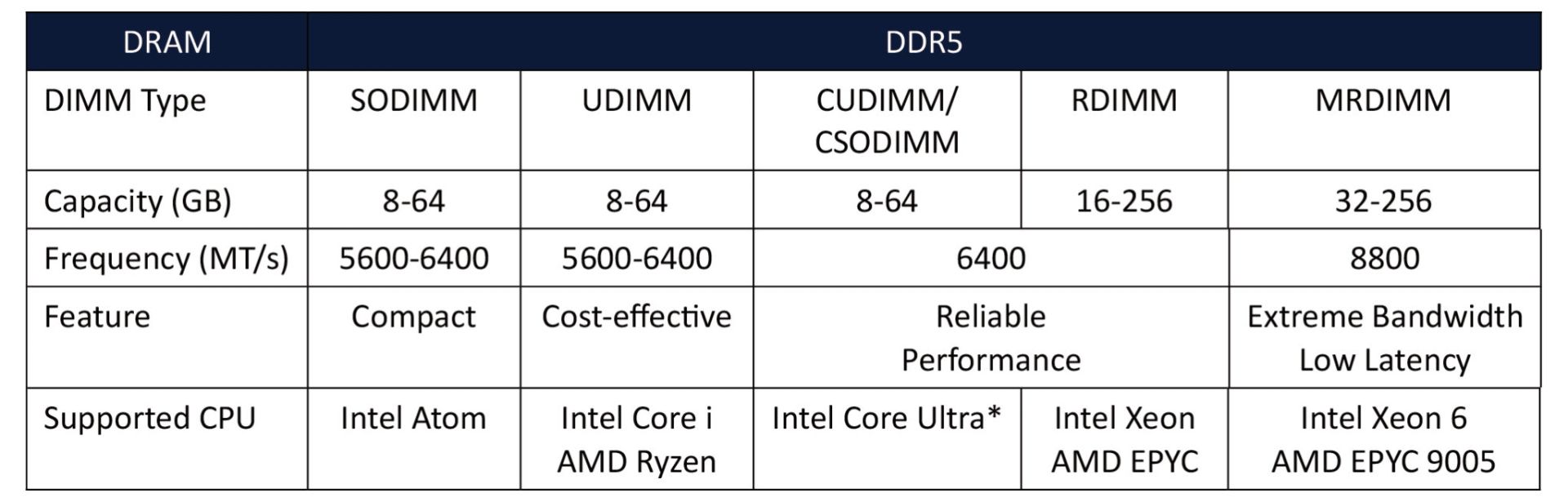
*Intel Core Ultra supports 6400 MT/s while Intel Core Processors support the same DIMM support with BIOS updates and 5600 MT/s limit due to the CPU spec.
**The spec and supported CPU may vary from time to time based on the current market.
- SODIMM: Compact Memory for Space-Constrained Systems
Small Outline DIMMs (SODIMMs) feature compact form factors ideal for embedded systems, industrial PCs, and compact network appliances. Roughly half the size of standard DIMMs, SODIMMs excel where space and thermal efficiency are critical.
- UDIMM: Cost-Effective Memory for Consumer and SMB Applications
Unbuffered DIMMs (UDIMMs) connect directly to the CPU’s memory controller to reduce latency and cost. They are suitable for general-purpose computing in consumer PCs and SMB environments.
- CUDIMM:Stable High-Speed Memory for Edge Systems
As AI-driven workloads push memory speeds higher, signal integrity issues like jitter and EMI become challenges. Clocked UDIMMs (CUDIMM) and Clocked SODIMMs (CSODIMM) integrate a Client Clock Driver (CKD) to improve signal integrity for enhanced stability and performance at higher frequencies.
- RDIMM:Reliable and Scalable Memory for Enterprise Servers
Registered DIMMs (RDIMMs) include a register buffer that stabilizes signal transmission between the memory controller and DRAM modules. This architecture reduces electrical load on the CPU and enhances stability which is critical for servers and workstations that run continuously under heavy loads.
- MRDIMM:Next-Generation High-Bandwidth Memory for Data Centers
Multiplexed Rank DIMMs (MRDIMMs) represent the latest advancement in server memory. MRDIMM leverages multiple ranks within a single module to deliver higher bandwidth and capacity for AI, ML, and data-intensive analytics.
Conclusion
As data growth continues to surge, the computing ecosystem evolves with innovations in scalability, bandwidth, and efficiency. DRAM remains fundamental to system performance, and the evolution from DDR5 to next-generation memory architectures will power the future of AI and high-performance computing with superior speed, stability, and scalability.