

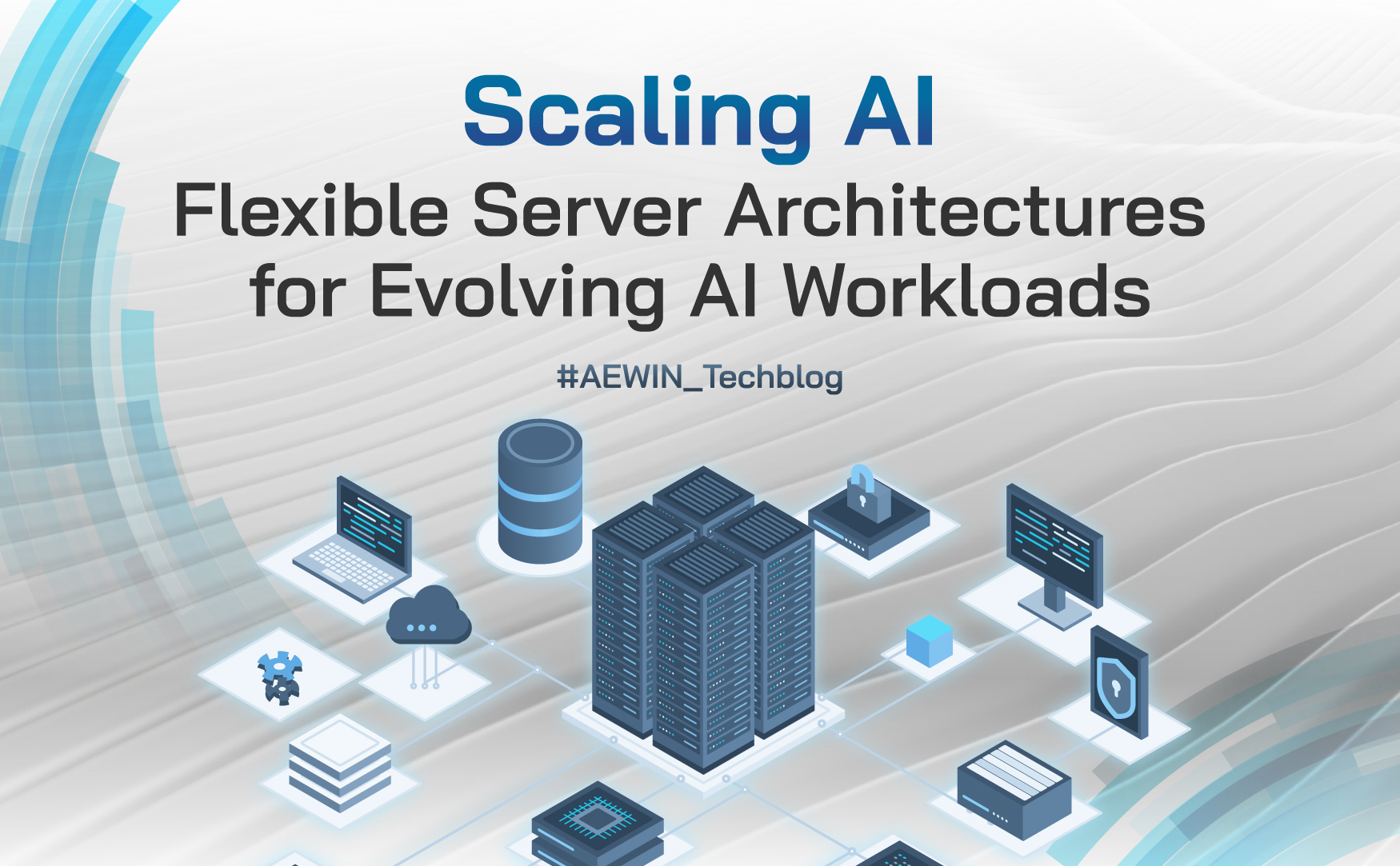
Scaling AI: Flexible Server Architectures for Evolving AI Workloads
Introduction
AI workloads are driving exponential demand for high-performance compute, memory, and system connectivity. Meeting these demands requires scalable server architectures that balance resource utilization, deployment flexibility, and total cost of ownership (TCO). Through modular design and configurable hardware, AEWIN provides servers that support multi-dimensional scaling strategies, helping customers adapt their AI infrastructure to evolving workloads.
Approaches to AI Scaling
At the server level, AI infrastructure can scale across various dimensions, from optimizing individual server configurations to expanding computing resources within a system and connecting multiple servers into larger clusters. The table below compares these three core strategies: Scale In, Scale Up, and Scale Out.
|
Scaling Approach |
Primary Focus |
Key Considerations |
|
Scale In |
Optimize resources within a server |
Component Integration Workload-Aligned Configuration TCO Optimization |
|
Scale Up |
Increase computing capacity within a server |
CPU & Memory Scaling PCIe Expansion for GPUs CXL Memory Extension |
|
Scale Out |
Expand cluster scale across multiple servers and racks |
High-Speed NICs (OCP 3.0 / PCIe) Inter-Node Interconnect Rack-Scale Integration |
Scale In: Optimizing High-Density Server Design
Scale In focuses on optimizing internal resource allocation and component density. Aligning CPU, memory, storage, and rich I/O configurations with actual workload demand allows organizations to maximize single-server capability and accelerate deployment. Additionally, utilizing modular architecture simplifies system-level integration and significantly lowers TCO.
Scale Up: Maximizing Computing Capacity
Scale Up vertically boosts the processing power and throughput of a single server to manage intensive workloads. Depending on the platform, this is achieved by upgrading to higher-tier CPU SKUs, expanding GPU accelerators, incorporating high-speed memory (including CXL 3.0), and leveraging ultra-high-speed connectivity for demanding AI applications.
Scale Out: Expanding Multi-Server Clusters
Scale Out horizontally expands computing capacity by interconnecting multiple server nodes through high-speed networking. High throughput NICs and advanced switches drive seamless communication across nodes and racks for massive AI clusters. As deployments scale, optimizing network bandwidth, latency, and traffic control also become essential considerations.
AEWIN Enables AI Infrastructure Scaling
Flexible Modular Design for Scale In
AEWIN develops servers with a modular design aligned with OCP DC-MHS architectures to allow for flexible configurations, accelerate customization, and streamline deployments. By integrating configuration requirements from the initial stage, AEWIN helps customers tailor platforms to target workloads while optimizing resource utilization.
Configurable Hardware for Scale Up
AEWIN servers offer flexible computing configurations, supporting a wide range of CPU SKUs, memory slots, and PCIe expansion slots for GPUs and other accelerators. Additionally, CXL 3.0 support provides advanced memory expansion to deliver higher capacity. These capabilities enable customers to build scalable hardware solutions tailored for critical data processing, AI inference, and model training.
High-Speed Connectivity for Scale Out
AEWIN servers support high-speed NICs, serving as computing building blocks for larger AI deployments. Leveraging the advanced technologies of Qisda Group ecosystem, they can be integrated with advanced 1.6T switches and two-phase direct liquid cooling (2P DLC) solutions to enhance thermal management efficiency and unlock sustainable, rack-scale AI infrastructure for high-density computing.
Summary
Scale In, Scale Up, and Scale Out address various aspects of AI infrastructure expansion, from server configuration to computing expansion and cluster connectivity. With flexible server architectures and the Qisda Group ecosystem, AEWIN empowers customers to scale AI computing resources to meet evolving workload demands while balancing performance, flexibility, and TCO.