

Generative AI is Changing Our World
Introduction
As claimed by Nvidia CEO Jensen Huang in the latest GTC, the generative AI future is now. The first explosion took place in 2022 when ChatGPT get announced. Over 100 million users join the feast to experience the benefits of AI. After the duration of experimentation of various kinds of open models in 2023, here we are, entering the era of accelerated infrastructure in 2024.
What is Generative AI
Generative AI (Generative artificial intelligence, also known as GenAI or GAI) is AI capable of generating content. The procedure is divided by three parts including input information, model training and output.
- Input Information
Data input includes texts, images, videos, training models, molecular structures, and more. GPU can help to accelerate exploratory data analysis and speed up the preparation stage of data collection.
- Model Training
Generative model training includes supervised learning and unsupervised learning. Unsupervised learning is a crucial technique of generative AI models. Unlike supervised learning, where models are trained with labeled data (data with specific classifications), unsupervised training can deal with raw data lacking predefined categories or classifications.
- Output
After learning from the input training data with models, new content will be generated. The output includes texts, images, audios, videos, codes, recognized molecular structures, etc.
How is Generative AI Transforming Business
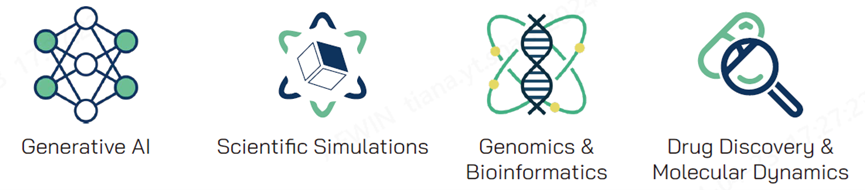
Generative AI benefits various kinds of applications including text generation, translation, coding, visual content creation, and life science. Among them, healthcare and life sciences are the largest data industry with 36% CAGR by 2025 according to research of RBC Capital Markets. It covers medical imaging, scientific simulations, genomics & bioinformatics, drug discovery, and digital healthcare.
- Image Segmentation
Generative AI models can be trained to segment specific structures within medical images, such as tumors or organs. With the enhancement of image segmentation, better efficiency and accuracy of AI model development can be achieved. Moreover, generative AI can be used to enhance the quality of medical images. The improved visualization assists doctors to perform better diagnosis.
- Early Disease Detection
Generative AI can analyze medical images like X-rays, MRIs, and CT scans to identify subtle abnormalities that might be missed by manual observation. To detect disease in early stage helps patient to get treatment before getting worse which may increase the cure rate accordingly.
- Drug Discovery and Development
Shorten the period of drug development can be accomplished through generative AI as GenAI can create new virtual molecular with desired properties for aiding in the identification of potential drug candidates. Furthermore, AI models can analyze vast datasets of existing drugs and patient information to predict potential ones with higher success rates.
- Digital Healthcare
Generative AI can analyze a patient’s specific genetic makeup, medical history, and other factors to create personalized treatment plans with better effectiveness and fewer side effects. In addition, the operational efficiency is improved by utilizing GenAI to generate reports, summarize medical records, and schedule appointments.
Summary
Generative AI is changing our world. It benefits various kinds of applications while healthcare and life sciences are the largest data industry. From early disease detection to personalized treatment, enhanced efficiency and better effectiveness of diagnostic and treatment can be achieved with GenAI’s assistances.