

Why is SD-WAN needed?
Background
The wide area network (WAN) has always posed significant challenges for organization with distributed workforces. When organization expands their operation, it can be challenging for IT teams to efficiently deploy edge gear to connect users to business applications. The need for fast and reliable application performance and the complexity of day-to-day task such as configuration, monitoring, and management are now more important than ever.
To solve the challenges, SD-WAN is a technology quickly adopted by organizations as a cost-effective way to connect branch offices and other cloud applications.
What is SD-WAN
Briefing
SD-WAN technology centralizes network control by allowing organizations to quickly deploy and configure devices on remote site by using a single-pane-of-glass to monitor and control the WAN. SD-WAN can use many different types of circuits such as broadband, 4G LTE, MPLS to direct traffic to ensure performance and lower cost. Additionally, implemented SD-WAN can improve security with end-to-end segmentation and cloud-hosted security services.
How it Works
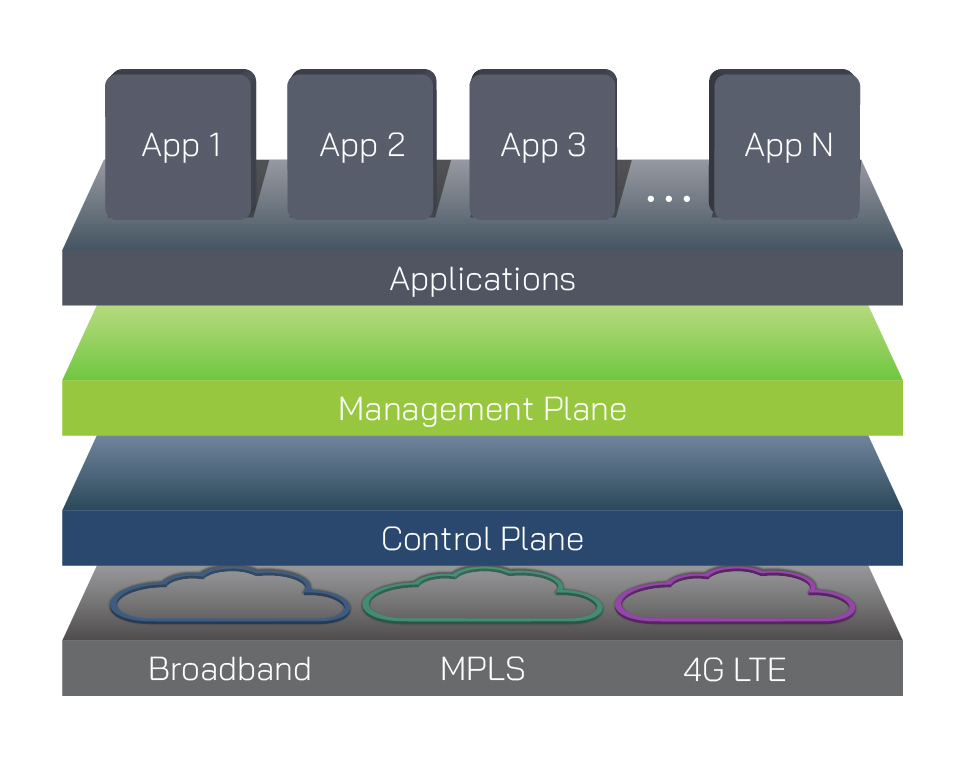
SD-WAN stands for Software-defined Wide Area Network, it is a software approach to manage WAN. SD-WAN architecture decouples or logically separates applications and the control and management functions from the WAN transport services like MPLS, Broadband, 4G LTE, 5G. That is, it separates the controller management plane from the data forwarding plane and use software to centralize the control.
Through the centralized controller, its policy rule determines which connection to use through continue monitoring of bandwidth utilization, packet loss, and latency. The centralized management controls provide single-pane-of-glass view of application services and local device usage on the entire WAN and can gain greater insights to prioritize traffic base on those data.
Benefits
- Centralized Orchestration and Increased Availability
As organization grows and more branches are added, the network becomes more complex and harder to manage. Each device needs to be configured and monitor individually. SD-WAN eliminates the need to use multiple interfaces by providing administrator a single-pane-of-glass console to monitor and manage the WAN. IT can use a location’s existing WAN connections with the SD-WAN devices and remotely manage the site policies via the centralize controller.
- Enhanced Agility and Rapid Responsiveness
SD-WAN uses its key feature of zero-touch provisioning to automate device connection. It can deliver optimal application performance under any network condition or changes including congestion and when impairments occur. SD-WAN offers redundancy among WAN connections, automatically failing over to a second path if the primary one fails or becomes unavailable. SD-WAN can use load balancing across multiple connections to improve application and network performance.
- Cost Reduction
MPLS have been the trusted go-to connectivity option for organization for decades, but it is costly and inflexible for upgrade. SD-WAN can reduce ongoing operating expenses by using commodity broadband and mobile technologies along with MLPS. In addition to the cost-effective and easy installation of SD-WAN for faster time to revenue, future updates and scaling are easy to perform with cloud-based option to even lower the overall cost for fitting the evolved ecosystem.
- Integrated Security & Access to Cloud
Instead of routing traffic through a data center to access the cloud, SD-WAN allows users to directly connect to the cloud using Internet. Cloud-hosted security services provide more comprehensive and consistent security enforcement vs. on premise security solutions. The centralized robust end-to-end segmentation could have prevented many of the security breaches. With integrated SSL decryption, enterprise firewall, intrusion prevention, app filtering, etc., SD-WAN can help to protect business confidential information.
Conclusion
SD-WAN provides high-performance, fast-speed, secure networking with centralized orchestration and availability. Compared to MPLS, which needs to backhaul traffic to data center, SD-WAN can directly access the cloud, dramatically increase user experience and usage. Moreover, SD-WAN solution has the benefit of enhanced flexibility to scale connectivity up and down depending on diverse demands with reduced cost and improved security.
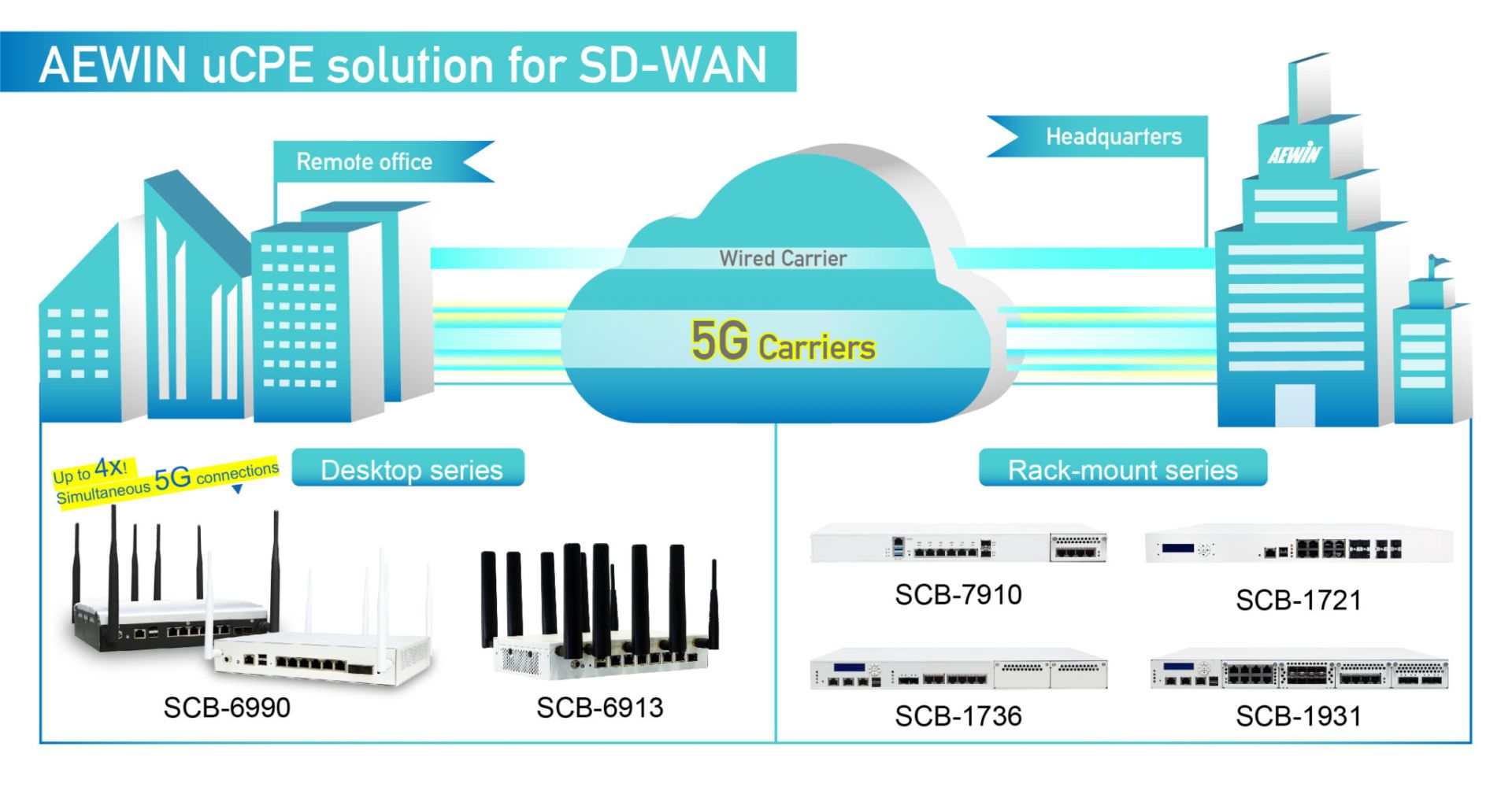
To help you build SD-WAN solution easily, AEWIN provides a full range of platforms from entry level SCB-6990/ SCB-6913/ SCB-7910, to mainstream SCB-1721/ SCB-1736 to performance SCB-1931. For learning more about SD-WAN and our offerings, please visit: https://www.aewin.com/solutions/sd-wan-vcpe/.