

2021.07.19

Redfish-Open Industry Standard Protocol

Share:

System management traditionally had relied on the venerable IPMI protocol standard established in 1998. Since then, there has been considerable advancement in technology and command-line tools fell out of favor as compared to modernized GUI that can visualize the process into an intuitive interface. Enter the Redfish specifications published by DMTF (Distributed Management Task Force).

Redfish is an open industry standard protocol aiming to utilize modern web standards capable of managing large scale deployment of servers today. This standard utilizes the common RESTFUL web interface as well as the JSON data format. These are common standards utilized on the internet, easing the development and compatibility of the management utilities. These web technologies also enable server management and monitoring through common web browsers, streamlining the process. Since Redfish is designed in the modern era, there are significantly better integration of system BIOS and on-board BMC.

Ultimately, Redfish allows server administrators to control large scale deployment of servers worldwide. The current IPMI tools are not friendly to automations and became fragmented as vendors keep building on their own proprietary IPMI commands that are not interoperable and complicated to manage in a mixed vendor environment. Through standardizing on Redfish, future tools will allow a single administration panel to work across different server brands as long as it supports the Redfish standard. This also opens the possibility of 3rd party management tools. Through common scripting languages like Python and PowerShell, administrators can automate management, updating, and deployment through familiar tools.

AEWIN is phasing in Redfish support across many different platforms. AEWIN’s recently announced 1932 and 1937, based on the latest processors from Intel and AMD respectively, are among the first to support this versatile new standard.
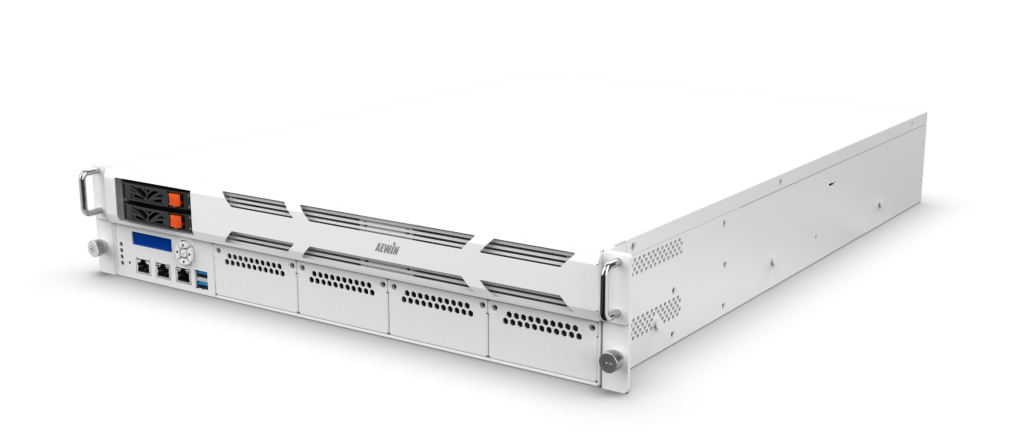
SCB-1932 Network Appliance | Edge computing server
Support Dual 3nd Gen Intel® Xeon® Scalable Processors, LGA4189
16x DDR4 3200MHz memory
8x PCIe x8 for Network Expansion Module
2x 2.5” HDD/SSD, 2x M.2 2280 & 1x m-SATA
Support OT006A/B Trusted Secure Boot modules
SCB-1937 Network Appliance | Edge computing server
Support Dual AMD® EPYC™ 7003/7002 Series Processors, LGA4094
16x DDR4 3200MHz memory
8x PCIe x8 for Network Expansion Module
2x 2.5” HDD/SSD, 2x M.2 2280 & 1x m-SATA
Support OT004A Trusted Secure Boot modules 

Related News

Rack-Scale AI Infrastructure: Maximizing Performance, Efficiency, and Scalability for the AI Era
2026.06.30

Rack-Scale AI Infrastructure: Maximizing Performance, Efficiency, and Scalability for the AI Era

Driven by the explosion of Gen AI, Agentic AI, and the massive datasets behind them, computing infrastructure is evolving from standalone servers to rack-scale architectures. Modern AI workloads require a tightly integrated combination of computing, networking, storage, and cooling solutions to deliver maximum performance and efficiency. Future-Ready AI Infrastructure has become the foundation for the AI Era.

Enhancing Network Resilience with AEWIN Gen4 LAN Bypass
2026.06.30

Enhancing Network Resilience with AEWIN Gen4 LAN Bypass

Traditional LAN bypass focuses on keeping traffic flowing when a system goes down, but modern deployments require greater flexibility to balance availability and security. AEWIN Gen4 LAN bypass builds on the Gen3 foundation by introducing enhanced traffic control mechanisms to enable network behavior to better align with real-world operational demands.

Optimizing Thermal Design for High-Performance Network Appliances and Servers
2026.06.30

Optimizing Thermal Design for High-Performance Network Appliances and Servers

As modern data centers and network infrastructures continue to scale, the demand for higher computing performance is rapidly increasing. This trend drives CPU power consumption to new levels, especially with the latest server-grade processors. As a result, optimized thermal management has become a critical design factor that directly impacts system stability and performance. High-performance network appliances and servers require advanced cooling solutions to sustain performance under heavy workloads.

Inquiry Cart

total 0 items

Compare

total 0 items

Email Subscribe

Verification

Click the numbers from smallest to largest.

We use cookies to allow our website to work properly, personalize content and advertising, provide social media features and analyze traffic. We also share information about your use of our site with our social media, advertising and analytics partners

Manage Cookies

Privacy Settings

We use cookies to allow our website to work properly, personalize content and advertising, provide social media features and analyze traffic. We also share information about your use of our site with our social media, advertising and analytics partners

Privacy Policy

Manage Consent Settings

Essential Cookies

Accept All

The website cannot function without these cookies and you cannot switch them off on your system.

These cookies are typically set only in response to an action you perform (i.e. a service request), such as setting privacy preferences, logging in, or filling in a form.

You can set your browser to block or prompt you for these cookies, but this may prevent some site features from working.