


AEWIN Has Completed 2024 Carbon Footprint Verification
Introduction
As global awareness of environmental issues grows, companies are increasingly held accountable for their environmental impact. As Carbon dioxide (CO2) makes up the vast majority of greenhouse gas emissions, it has been used as a benchmark for assessments. Carbon audits help businesses identify and reduce their carbon footprint, ensuring compliance with regulations and advancing sustainability goals. This blog explores AEWIN’s carbon footprint verification process and its journey toward robust ESG integration.
The Importance of Carbon Footprint Verification
Carbon footprint verification involves identifying, measuring, and reporting the greenhouse gases (GHGs) emissions generated by an organization’s activities. This process not only helps identify the sources of emissions but also sets a foundation for developing effective reduction strategies. For AEWIN, it aligns with the company’s ESG roadmap, reinforcing its commitment to sustainability and responsible governance.
Scope and Methodology of AEWIN’s Carbon Footprint Verification
AEWIN’s carbon footprint verification for the year 2024 follows the standards of ISO 14064-1:2018. It ensures comprehensive documentation and accurate reporting of all GHG emissions within the company’s operational boundaries covering its headquarters, factory, and warehouses in New Taipei City, Taiwan.
The emissions are categorized as:
Scope 1 (Direct Emissions): These direct emissions come from fixed and mobile combustion sources, such as company vehicles and on-site fuel usage. AEWIN also accounts for emissions from equipment like fire extinguishers, refrigeration units and CO2 cylinder (for soda water machines), providing a complete picture of its direct GHG impact.
Scope 2 (Indirect Emissions): Purchased electricity source from Taiwan Power Company is the primary of indirect emissions.
Scope 3 (Indirect Emissions): It covers employee commuting and business travel.
Scope 4 (Indirect Emissions): Generated by the use of products or services by the organization, it involves upstream emissions including purchased electricity and water resources.
Scope 3 and Scope 4 are added to make the verification complete and set 2024 as the base year for greenhouse gas verification, marking a milestone in systematic sustainability tracking.
Carbon Footprint Calculation
AEWIN used the following standard formula based on ISO 14064-1:2018 and IPCC AR6:
GHG Emissions = Activity Data × Emission Factor × Global Warming Potential (GWP)
●Activity Data represents the quantity of an activity, such as the amount of fuel burned, or a product produced.
●Emission Factor is the amount of greenhouse gas emitted per unit of activity, e.g., the amount of CO₂ produced per liter of gasoline.
●Global Warming Potential (GWP) is a measure of the relative warming impact of a greenhouse gas compared to carbon dioxide. For the values of GWP, AEWIN applied the latest IPCC AR6 standards.
By this calculation, the total greenhouse gas emissions could be determined in terms of carbon dioxide equivalents.
Results: AEWIN’s 2024 Carbon Footprint
The results of AEWIN’s carbon footprint verification reveal critical insights into the company’s environmental impact. For the period from January 1, 2024, to December 31, 2024:
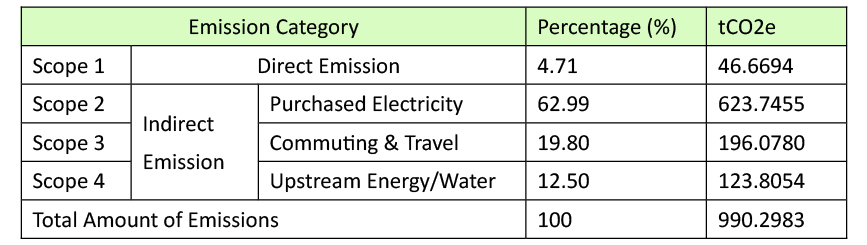
●Direct GHG Emissions (Scope 1): AEWIN’s direct GHG emissions amounted to 46.6694 metric tons of CO2, accounting for 4.71% of the company’s total emissions.
●Indirect GHG Emissions (Scope 2+3+4+5): Indirect emissions totaled 943.6289 metric tons of CO2, making up 95.29% of the overall emissions.
This comprehensive breakdown helps AEWIN understand the relative impact of different activities and target specific areas for improvement.
Strategies for ESG Advancement
AEWIN is committed to integrating ESG principles into its core operations. Carbon footprint verification is a pivotal part of this approach, providing a foundation for ongoing improvement and innovation.
Based on the results of the GHG Emissions, the most significant and controllable emission source at AEWIN is Scope 2 emissions—indirect greenhouse gas emissions from purchased electricity. In response, AEWIN will continue to implement targeted energy-saving initiatives to reduce its carbon footprint and fulfill its ESG commitments. Key initiatives include:
●Promoting Energy Conservation: Advocating company-wide awareness and action to reduce electricity consumption in daily operations.
●Enhancing Operational Efficiency: Streamlining internal processes and promoting energy-saving behaviors to eliminate unnecessary energy waste.
●Upgrading Equipment Performance: Improving equipment efficiency through regular maintenance and optimization, with a focus on minimizing refrigerant leakage.
Conclusion
AEWIN’s 2024 carbon footprint verification marks a significant achievement in its ESG journey. By conducting a comprehensive and certified GHG inventory report, AEWIN sets a transparent baseline for future reductions and shows its commitment to climate action. Through continuous improvement, AEWIN aims to deliver sustainable value to the environment and society.