

2024.08.27

Extraordinary Data Encryption and Compression with Intel QAT 4 of 4th/5th Gen Xeon and Xeon 6 Processors

Share:

Introduction
The exponential growth of data presents a double-edged sword. While valuable information flourishes, so does the need for robust security measures. Encryption, a cornerstone of data protection, can be computationally expensive and cause heavy stress to computing cores of CPUs. This is where crypto acceleration and Intel Quick Assist Technology (Intel QAT) steps in.

Intel QAT History
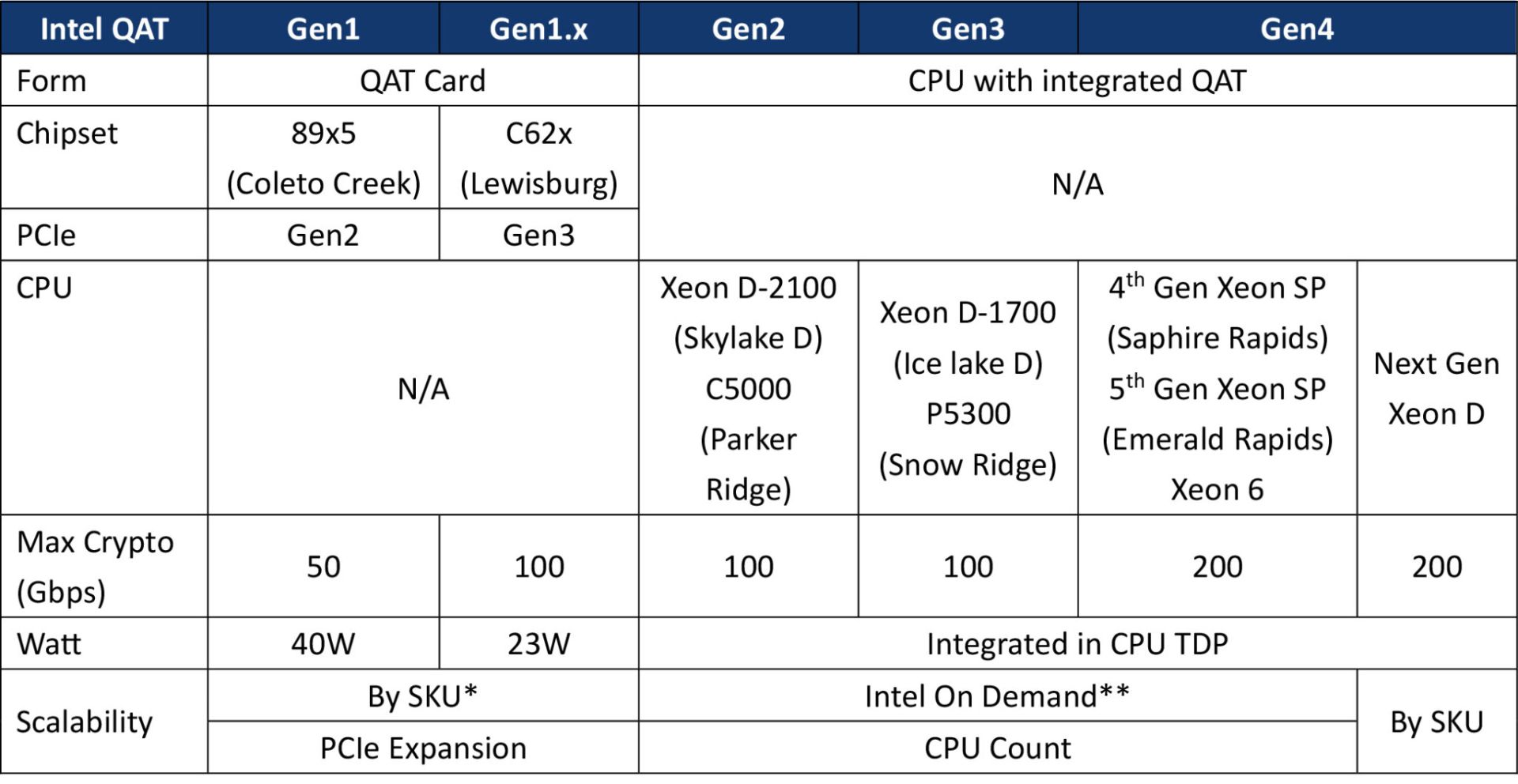
Intel QAT was introduced back in 2007, initially available as an add-in PCIe card built with an Intel PCH, Coleto Creek chip. Later on, Intel QAT has been also integrated in Intel CPU including Xeon-D and Atom processors. Over the years, it has evolved through several generations. And the latest Xeon SP CPUs are integrated with Intel QAT Gen4 with enhanced performance.

Intel QAT Evolution
QAT-02-2048x1059

* Different SKUs of QAT cards are available with different chipsets such as 8925, 8955, C626, and C627 to offer different max crypto throughput and power consumption.
** Intel On Demand features offer upgrades with maximum 4 QAT accelerators in selected processor SKU in Intel Xeon Scalable Processors to enable advanced performance for high-performance computing.

Intel QAT has evolved with increased maximum crypto throughput from 50Gbps to 200Gbps and can scale up to 400Gbps with two Xeon SP processors. Apart from the enhanced performance, the evolution of integrated QAT freeing up space in the server chassis as there is no need of expansion slots required by hardware acceleration cards. In addition to saving valuable space for deployment, the integrated solution further reduces the overall system complexity.

Intel QAT 4 Stands Out
QAT-03-2048x549

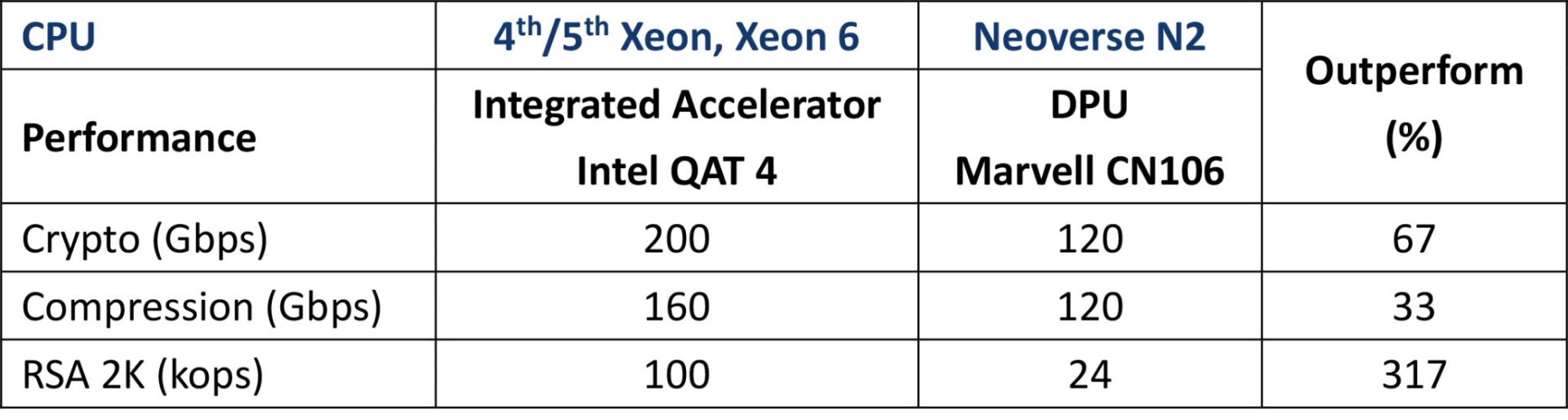
Intel QAT 4 integrated in 4th/5th Gen Xeon and Xeon 6 processors is with outstanding acceleration for cryptography and compression. Compared to Marvell DPU, CN106, Intel QAT 4 performs 67% -317% better for crypto acceleration and 33% better regarding the data compression acceleration. Besides, Intel QAT 4 is integrated in x86 processor supporting easier deployment with mature software ecosystem while Marvell DPU integrates ARM processor with less scalability.

Summary
Hardware acceleration has evolved with data surge to bring outstanding acceleration for cryptography and compression. Intel QAT 4 integrated into the latest Xeon processors delivers exceptional performance, outperforming competitors like Marvell CN106. The built-in Intel QAT 4 not only boosts crypto acceleration, but also simplifies server architecture and optimizes space deployment, making it a perfect solution for compute-intensive applications.

Related News

Rack-Scale AI Infrastructure: Maximizing Performance, Efficiency, and Scalability for the AI Era
2026.06.30

Rack-Scale AI Infrastructure: Maximizing Performance, Efficiency, and Scalability for the AI Era

Driven by the explosion of Gen AI, Agentic AI, and the massive datasets behind them, computing infrastructure is evolving from standalone servers to rack-scale architectures. Modern AI workloads require a tightly integrated combination of computing, networking, storage, and cooling solutions to deliver maximum performance and efficiency. Future-Ready AI Infrastructure has become the foundation for the AI Era.

Enhancing Network Resilience with AEWIN Gen4 LAN Bypass
2026.06.30

Enhancing Network Resilience with AEWIN Gen4 LAN Bypass

Traditional LAN bypass focuses on keeping traffic flowing when a system goes down, but modern deployments require greater flexibility to balance availability and security. AEWIN Gen4 LAN bypass builds on the Gen3 foundation by introducing enhanced traffic control mechanisms to enable network behavior to better align with real-world operational demands.

Optimizing Thermal Design for High-Performance Network Appliances and Servers
2026.06.30

Optimizing Thermal Design for High-Performance Network Appliances and Servers

As modern data centers and network infrastructures continue to scale, the demand for higher computing performance is rapidly increasing. This trend drives CPU power consumption to new levels, especially with the latest server-grade processors. As a result, optimized thermal management has become a critical design factor that directly impacts system stability and performance. High-performance network appliances and servers require advanced cooling solutions to sustain performance under heavy workloads.

Inquiry Cart

total 0 items

Compare

total 0 items

Email Subscribe

Verification

Click the numbers from smallest to largest.

We use cookies to allow our website to work properly, personalize content and advertising, provide social media features and analyze traffic. We also share information about your use of our site with our social media, advertising and analytics partners

Manage Cookies

Privacy Settings

We use cookies to allow our website to work properly, personalize content and advertising, provide social media features and analyze traffic. We also share information about your use of our site with our social media, advertising and analytics partners

Privacy Policy

Manage Consent Settings

Essential Cookies

Accept All

The website cannot function without these cookies and you cannot switch them off on your system.

These cookies are typically set only in response to an action you perform (i.e. a service request), such as setting privacy preferences, logging in, or filling in a form.

You can set your browser to block or prompt you for these cookies, but this may prevent some site features from working.