

2023.05.12

Meeting ESG Requirements with Two-phase Immersion Cooling Design

Share:

Introduction
Sustainability and ESG (Environmental, Social, Government) have become critical missions that everyone has to carry out. The growing awareness and the government strategy of Net zero and carbon taxes make companies come up with solutions to meet up the goal. As for hardware device wise, to reach lower PUE (Power Usage Effectiveness) is one of the approaches. With two-phase immersion cooling design on AEWIN high performance network appliance, PUE can be lower. In this Tech Blog, we will be introducing the design and its benefits for improving the sustainability with two-phase immersion cooling design.

Improved PUE with Two-phase Immersion Cooling Design
What is Two-phase Immersion Cooling
Two-phase immersion cooling is a data center cooling technology. In the two-phase immersion cooling computing system, the electronic parts are immersed in the non-conductive cooling liquid, which boils at a low temperature and efficiently removes heat from the components. The immersion liquid is typically a specially formulated fluid. When the electronic components are immersed in the liquid, the heat generated by the components causes the liquid to boil and turn into a vapor. The vapor then rises to the condenser, where it is cooled and condenses back into a liquid. The condensed liquid then flows back down into the container and is once again in contact with the electronic components, providing continuous cooling.
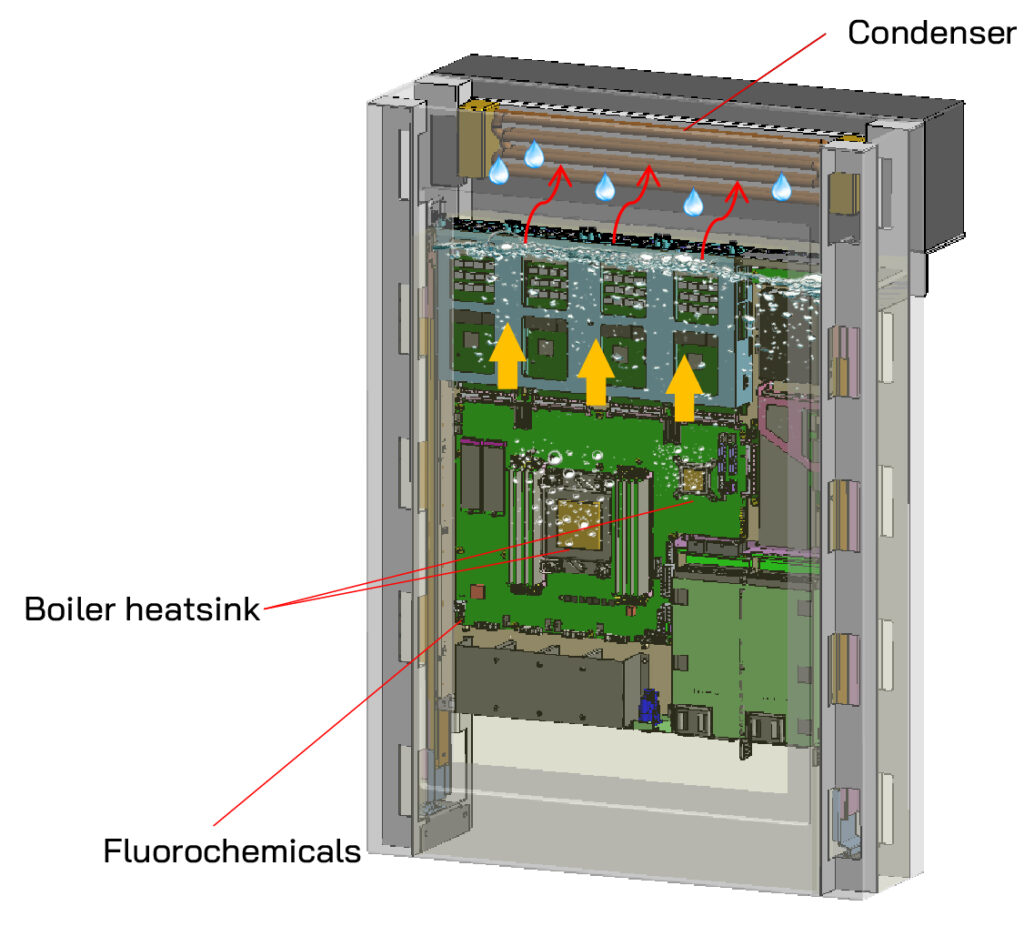
ALL_news_tech_blog_26A12_FW6Cou87GT

The Benefits of Two-phase Immersion Cooling
The main advantage of two-phase immersion cooling over traditional air-cooling is its efficiency of cooling as the dielectric liquid has a much higher heat capacity than air. It can effectively help to lower the power consumption of the total system as no other devices are required for the cooling. Fans for air-cooling would no longer be needed in two-phase immersion cooling which makes the whole system relatively quiet that may be beneficial to certain applications. As fan is with high failure rate and it would not be used in the two-phase immersion cooling design, the reliability of the whole system can also be improved. Furthermore, the density of power and computing can be increased as there is no need to consider the height of the heat dissipation interface and components that would affect the air flow.

AEWIN Cooperates with KENMEC to Provide Low PUE Solution
As two-phase immersion cooling is one of the efficient liquid cooling technologies, AEWIN cooperates with KENMEC and ITRI to enable a two-phase immersion cooling design on AEWIN’s latest Network Appliance, SCB-1946 series, for better thermal management and enhanced energy efficiency. AEWIN SCB-1946 powered by 2x 400W AMD EPYC 9004 (Genoa) CPUs with KENMEC two-phase immersion cooling design achieves a heat dissipation capacity of over 2000W (with 2x NVIDIA data center GPUs and four NIC cards installed) for the immersion system and the PUE approaches 1.0, meeting the low-carbon energy-saving goals and ESG (environmental, social, and governance) requirements, while also reducing operational costs from an economic perspective.

Summary
Applying two-phase immersion cooling design on high performance network appliance has advantages of efficiency, reliability, and higher computing density. AEWIN SCB-1946 with KENMEC two-phase immersion cooling design achieves lower PUE, reduced OPEX, and meet ESG requirements all at the same time.
Related News

Rack-Scale AI Infrastructure: Maximizing Performance, Efficiency, and Scalability for the AI Era
2026.06.30

Rack-Scale AI Infrastructure: Maximizing Performance, Efficiency, and Scalability for the AI Era

Driven by the explosion of Gen AI, Agentic AI, and the massive datasets behind them, computing infrastructure is evolving from standalone servers to rack-scale architectures. Modern AI workloads require a tightly integrated combination of computing, networking, storage, and cooling solutions to deliver maximum performance and efficiency. Future-Ready AI Infrastructure has become the foundation for the AI Era.

Enhancing Network Resilience with AEWIN Gen4 LAN Bypass
2026.06.30

Enhancing Network Resilience with AEWIN Gen4 LAN Bypass

Traditional LAN bypass focuses on keeping traffic flowing when a system goes down, but modern deployments require greater flexibility to balance availability and security. AEWIN Gen4 LAN bypass builds on the Gen3 foundation by introducing enhanced traffic control mechanisms to enable network behavior to better align with real-world operational demands.

Optimizing Thermal Design for High-Performance Network Appliances and Servers
2026.06.30

Optimizing Thermal Design for High-Performance Network Appliances and Servers

As modern data centers and network infrastructures continue to scale, the demand for higher computing performance is rapidly increasing. This trend drives CPU power consumption to new levels, especially with the latest server-grade processors. As a result, optimized thermal management has become a critical design factor that directly impacts system stability and performance. High-performance network appliances and servers require advanced cooling solutions to sustain performance under heavy workloads.

Inquiry Cart

total 0 items

Compare

total 0 items

Email Subscribe

Verification

Click the numbers from smallest to largest.

We use cookies to allow our website to work properly, personalize content and advertising, provide social media features and analyze traffic. We also share information about your use of our site with our social media, advertising and analytics partners

Manage Cookies

Privacy Settings

We use cookies to allow our website to work properly, personalize content and advertising, provide social media features and analyze traffic. We also share information about your use of our site with our social media, advertising and analytics partners

Privacy Policy

Manage Consent Settings

Essential Cookies

Accept All

The website cannot function without these cookies and you cannot switch them off on your system.

These cookies are typically set only in response to an action you perform (i.e. a service request), such as setting privacy preferences, logging in, or filling in a form.

You can set your browser to block or prompt you for these cookies, but this may prevent some site features from working.

Marketing Cookies

Marketing cookies are used to track visitors' journey through our website. The purpose is to display advertisements that are relevant or appealing to the individual user and are therefore more important to the publisher or third-party advertiser.

Targeting Cookies
These cookies are set through our site by advertising partners. These companies may use cookies to build a profile of your interests and show you relevant adverts on other sites. They only need to recognise your browser and device to work. If you do not allow these cookies, you will not experience targeted advertising across different websites.

Social Media Cookies
These cookies are set by a range of social media services that we have added to our site to enable you to share our content with your friends and networks. They can track your browser across other websites and build a profile of your interests. This may affect the content and messages you view when you visit other websites. If you do not allow these cookies, you may not be able to use or view these sharing tools.