


New standards in wireless connectivity: pros, cons, and where they make sense
Wifi 6, Wifi 6e, 5G NR, and 802.11ah (HaLow) are some of the new connectivity solutions being proposed. The route each have taken has distinct advantages for specific applications. We’ll take a brief look at each.
Wifi 6 and its extension 6, 802.11ax in IEEE jargon, is the next iteration of the standard wifi we encounter everyday. The main upgrade from Wifi 5 is the higher order 1024-QAM modulation that allows higher transmission rates. MIMO/MU-MIMO now works in both directions with the implementation on the uplink side. Wifi 6e is the minor extension of the standard to denote the support for the 6Ghz bands. Wifi is a staple in wireless connectivity and easily accessible and available. It utilize unlicensed wireless bands for transmission. Due to the unlicensed nature, it has to share spectrum with multitude of devices broadcasting on these bands. Wifi is ubiquitous and has overpopulation problem in dense residential and commercial areas. Although newer wifi standards has better spectrum sharing behavior, the legacy networks utilizing the older specification still crowds the spectrum, particularly 2.4GHz band, and impacting ultimate wifi performance. Wifi is still a top choice where high bandwidth and energy usage are top criterias, particularly in installation where end devices are largely stationary and aren’t highly sensitive to intermittent latency spikes.
5G new radio has been exceedingly hot topic amongst enterprises. The radio cover a wide range of spectrums from sub 1GHz all the way up to 28GHz. In private enterprise uses, the focus has been the 3.5GHz and 4.5GHz bands. Of course, the bands beyond the 6GHz will have signal penetration and range limitations. 5G brings lower latency and increased bandwidth over previous cellular technologies. The push for whitebox hardware to provide the 5G stack has opened up non-traditional hardware vendors to step into this space, utilizing the familiar x86 equipments. The distinct advantage of 5G over Wifi is range. Being cellular based, it has integrated many technologies that allows the wireless spectrum to be shared with minimal impact on other devices on the same spectrum. Also thanks to the cellular technology, it can gracefully handle movement among different cell/radios. This makes it ideal for application where the devices are not static and can easily handle movement throughout the premises. The biggest disadvantage of this technology is the newness and its associated costs. The 5G radio on the device end also require more energy than the wifi solutions.

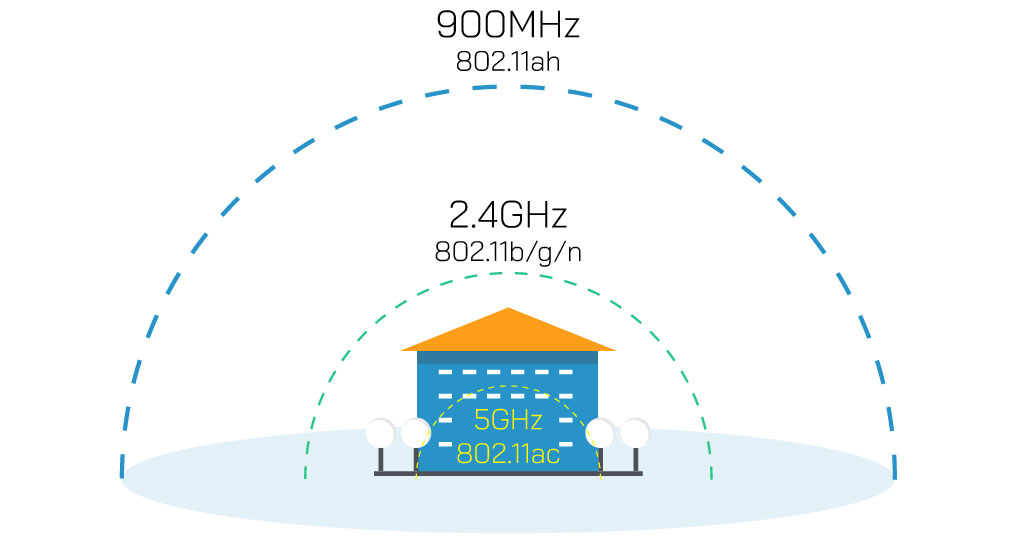
802.11ah (HaLow) is a new wifi standards. Why another wifi? HaLow is specifically designed for IoT usage, using unlicensed lower 900MHz band. It is designed for low power consumption on par with bluetooth radio, but with much longer range due to its use of longer wave length to help with signal penetration and fall off. It can support thousands of devices under the same access point. This solution is ideal for on-prem use where there are tons of smart devices/sensors. Through wireless connectivity, data can be aggregated and processed by a central server. The main catch of this technology is the bandwidth due to its lower frequency and low power design.
It is exciting time for wireless technologies. Many innovations and applications will be enabled by these connectivity options, each servicing their own targeted markets. All these technologies aim to keep devices around us connected for better and smarter devices. What applications can you dream up with these new connectivity options?