Introduction
Traditional LAN bypass focuses on keeping traffic flowing when a system goes down, but modern deployments require greater flexibility to balance availability and security. AEWIN Gen4 LAN bypass builds on the Gen3 foundation by introducing enhanced traffic control mechanisms to enable network behavior to better align with real-world operational demands.
AEWIN LAN Bypass Generational Comparison
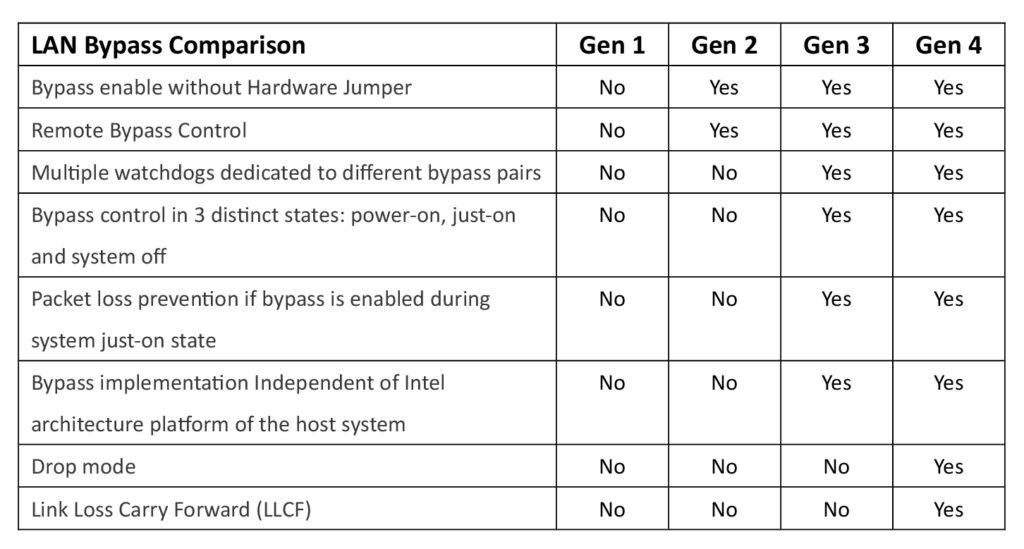
AEWIN Gen3 LAN bypass significantly improved reliability with features such as watchdog control, platform independence, and stable fail-open behavior for continuous connectivity during system failures. It establishes a solid and reliable bypass foundation. Building on this, Gen4 introduces behavior-level control to allow systems to respond differently depending on deployment requirements.
AEWIN Gen4 LAN bypass takes this a step further by adding Drop mode and Link-Loss mode. Instead of relying primarily on fail-open (bypass) behavior, the system can now either block traffic or actively signal the network to trigger failover. This enables a more flexible approach where network behavior can be adapted based on whether availability or security is the primary concern.
Further details of the four bypass modes are listed below.
- Normal Mode
In Normal Mode, all traffic is directed to the CPU for full inspection and policy enforcement. This is the standard operating state where all security, monitoring, and networking functions are fully active.
- Bypass Mode
When system failure occurs, Bypass Mode directly forwards traffic between ports without passing through the CPU. This ensures uninterrupted connectivity and represents the classic fail-open behavior which is adopted widely in firewalls and network monitoring tools to prevent downtime.
- Drop Mode
Drop Mode blocks all traffic from passing through the system. Although the link may still appear active, no data is transmitted. This mode is designed for security-critical scenarios where preventing uninspected traffic is more important than maintaining connectivity which is consistent with zero trust principles.
- Link-Loss Mode (LLCF)
Link-Loss Mode makes the connection appear disconnected to upstream devices when a failure is detected. To utilize Link-Loss Mode, the LLCF (Link Loss Carry Forward) feature must be enabled. This allows the system to physically simulate a cable disconnection, ensuring upstream devices can instantly detect the failure and trigger an HA failover.
Summary
AEWIN Gen4 LAN bypass enhances Gen3 designs by introducing Drop Mode and Link-Loss Mode to enable more flexible and intelligent handling of network traffic during failures. Instead of relying solely on fail-open behavior, AEWIN Gen4 bypass allows systems to either block traffic for security or trigger failover for high availability. It is critical for modern network infrastructures that demand both deterministic security control and resilient service continuity.