
Introduction
As modern data centers and network infrastructures continue to scale, the demand for higher computing performance is rapidly increasing. This trend drives CPU power consumption to new levels, especially with the latest server-grade processors. As a result, optimized thermal management has become a critical design factor that directly impacts system stability and performance. High-performance network appliances and servers require advanced cooling solutions to sustain performance under heavy workloads.
Advanced Thermal Design for Diverse Workloads
AEWIN leverages its experienced thermal engineering team to develop a wide range of cooling architectures tailored to different system requirements, including:
– CPU Heatsinks with various form factors
– Vapor Chambers (VC) for improved heat spreading
– Heat Pipes for efficient thermal transfer
– Air Guide Design to optimize airflow within compact chassis
These technologies are not implemented in isolation but are strategically combined to address specific thermal challenges across different form factors such as 1U and 2U systems.
- Flexible Heat Sink Design Based on TDP and Form Factor
To support various CPU TDP levels and deployment scenarios, AEWIN provides optimized heat sink modules designed for both Intel and AMD platforms. The following table summarizes representative configurations:
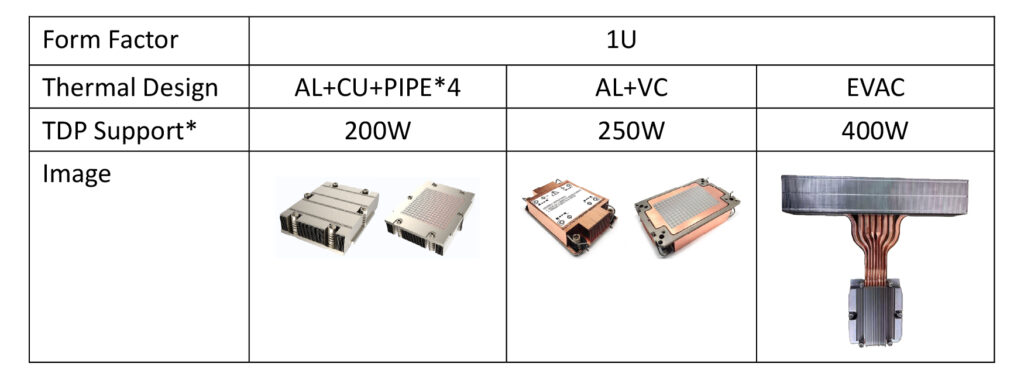
*: Ambient Temperature: 35 deg ℃
1U Heatsink Solutions features compact design for space-constrained systems. It is suitable for 1U rackmount systems or 2U systems with dual-width GPU card supported. There are heat pipes at the side of CPU to dissipate the heat from CPU to the fins.
Vapor Chamber, VC, is a flat, vacuum-sealed metal chamber used for high-efficiency cooling, functioning through the evaporation and condensation of an internal fluid. VC provides rapid heat diffusion which is suitable for high efficiency and compact thermal design.
Extended Volume Air Cooling, EVAC, applied more heatsink fins with extended heat pipes to increase surface area for heat dissipation. By integrating large and dense heatsinks with vapor chambers, it is designed to work with fans to maximize thermal transfer as a high-performance thermal solution applied in compact spaces.
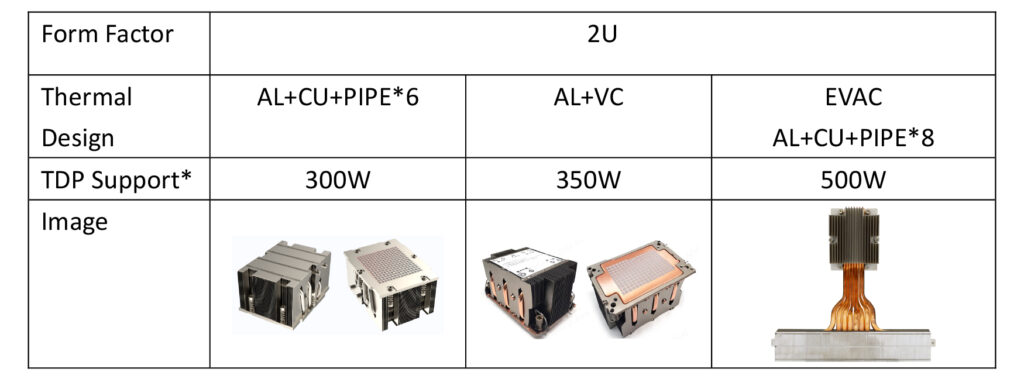
2U CPU heatsink provide better heat dissipation compared to 1U CPU heatsink as its larger physical volume increase surface area for heat dissipation. Also, deeper fins and a larger copper base, allowing for a lower thermal resistance and better heat absorption.
Same as 1U heatsink thermal design, further VC and EVAC can be applied to strengthen the thermal management based on the consideration of the same system chassis. In addition, the thermal solution can be designed per requirements.
- Customization for Specific Requirements
Beyond standard designs, AEWIN offers customized thermal solutions based on customer requirements, including:
– Tailored heat sink dimensions for specific chassis constraints
– Optimized airflow design based on system layout and NIC/GPU placements
– Custom fan profiles via BMC for workload-based thermal control
This flexibility ensures that each platform achieves optimal thermal efficiency while maintaining performance consistency under real-world workloads.
For example, applying dedicated fan and optimized heat pipes of the 2U CPU heat sink can increase the heat support to 400W under 35 deg ℃ ambient temperature.
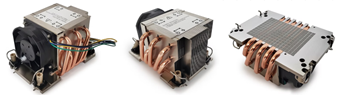
Image: Active 2U heatsink for TDP 400W
Summary
As CPU performance continues to scale and workloads become increasingly demanding, thermal design is evolving into a key differentiator in high-performance network appliances and servers. By combining advanced cooling technologies and flexible design capabilities, AEWIN delivers robust thermal solutions that ensure stability, efficiency, and scalability which is beneficial for customers to build next-generation infrastructure for intensive computing demands.